Cambodia Condemns Thai Military Airstrikes, Citing Violations of Sovereignty, International Law, and Cultural Heritage
Cambodia’s Ministry of Foreign Affairs has strongly denounced Thailand’s use of F-16 fighter jets in cross-border airstrikes, warning of severe civilian casualties, mass displacement, destruction of UNESCO-listed heritage sites, and breaches of international law. Phnom Penh calls for an immediate halt to military operations and a return to peaceful dialogue.
 orkun
orkun 
The Ministry of Foreign Affairs and International Cooperation of the Kingdom of Cambodia has issued a forceful condemnation of Thailand’s recent military actions along the Cambodia–Thailand border, describing them as a grave escalation that undermines regional stability and violates fundamental principles of international law.
According to the official statement released by the Ministry, Thai armed forces deployed F-16 fighter aircraft to conduct airstrikes on multiple locations inside Cambodian territory. Phnom Penh views these operations as a direct assault on Cambodia’s sovereignty and territorial integrity, incompatible with the United Nations Charter, the ASEAN Charter, and the core values underpinning the ASEAN Community.
Serious Breaches of International Norms
Cambodian authorities emphasized that the use of combat aircraft against targets within another sovereign state constitutes a manifestly disproportionate and unjustified use of force. Reports indicate that Thai military aircraft penetrated Cambodian airspace to a depth of approximately 80 to 90 kilometers, an action that Cambodia characterizes as both excessive and destabilizing.
Such operations, the Ministry stressed, represent a dangerous precedent in the region and risk further escalation if not immediately halted. The Cambodian government underscored that disputes between neighboring states must be resolved through diplomacy and legal mechanisms, not through military coercion.
Humanitarian Impact and Civilian Suffering
The consequences of the airstrikes have been devastating for civilians living in the affected border provinces. Cambodian officials report civilian fatalities, widespread destruction, and the displacement of more than 400,000 people, many of whom have been forced to flee their homes with little warning.
Entire communities have been left without access to basic services as civilian infrastructure sustained significant damage. Schools, hospitals, pagodas, residential homes, administrative buildings, bridges, and commercial establishments-including hotels and casinos-were reportedly damaged or destroyed. Among the affected structures is the Chey Chumneas Bridge, a key component of local transportation networks.
Damage to World Cultural Heritage
One of the most alarming aspects of the attacks, according to Phnom Penh, is the damage inflicted on sites of immense cultural, historical, and religious importance. Cambodian authorities stated that airstrikes affected UNESCO World Heritage sites, including the Preah Vihear Temple, as well as other ancient temples that hold deep national and spiritual significance.
Cambodia maintains that targeting or damaging cultural heritage sites constitutes a serious violation of international humanitarian law, including international conventions designed to protect cultural property during armed conflict. Such acts, the Ministry warned, cause irreversible harm not only to Cambodia, but to humanity’s shared heritage.
Call for Immediate Cessation of Hostilities
In its statement, the Ministry of Foreign Affairs urged the Thai military to immediately cease all aerial bombardments and any military operations that place civilians at risk. Phnom Penh called on Thailand to fully respect international law and to prioritize the protection of civilians and civilian objects in accordance with humanitarian principles.
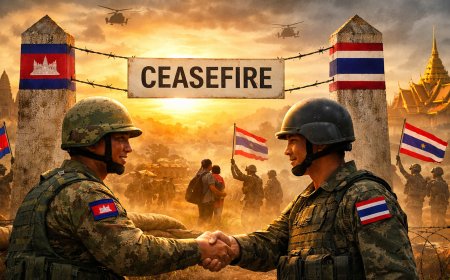
The Cambodian government reaffirmed its consistent and unwavering commitment to the Ceasefire Agreement of 28 July 2025 and the Kuala Lumpur Joint Declaration of 26 October 2025, both of which were intended to prevent escalation and promote peaceful conflict resolution.
Appeal for Dialogue and Peaceful Resolution
Concluding the statement, the Royal Government of Cambodia demanded that Thailand abandon the use of force as a means of addressing boundary-related issues and return to peaceful, law-based mechanisms for dispute resolution. Cambodian officials stressed that sustainable peace can only be achieved through dialogue, mutual respect, good neighborly relations, and adherence to international law.
Phnom Penh reiterated its readiness to engage constructively with regional partners and international institutions to safeguard peace, protect civilians, and preserve cultural heritage across Southeast Asia.