Cambodia and Thailand Agree Immediate Ceasefire Amid Border Clashes After Weeks of Violence
After weeks of intense and deadly border fighting that displaced hundreds of thousands of civilians and caused significant casualties, Cambodia and Thailand agreed to an immediate ceasefire on 27 December 2025. The agreement halts hostilities, freezes troop movements, and sets conditions for cooperation on de-mining and prisoner release. The move was welcomed globally, though challenges to lasting peace remain as both nations address deep-rooted territorial and political disputes.
 orkun
orkun 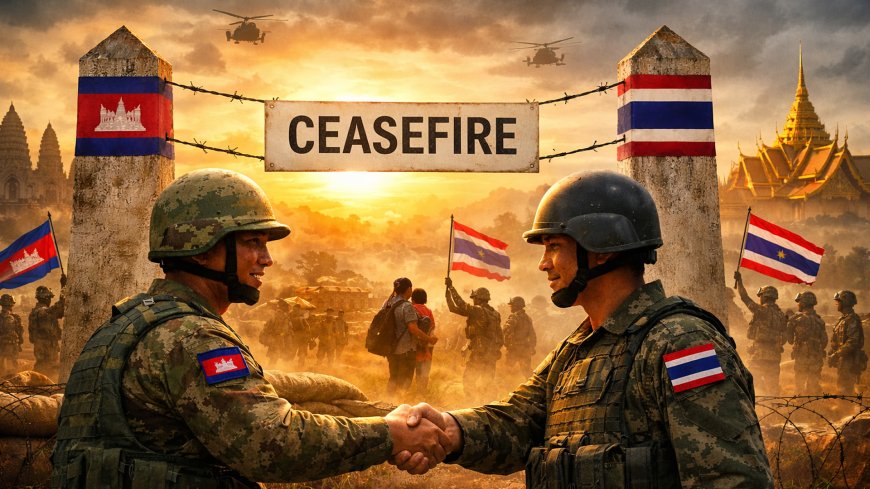
Phnom Penh, Cambodia - Cambodia and Thailand have agreed to an immediate ceasefire to end weeks of intense and deadly border clashes that erupted in late 2025, resulting in significant casualties, large-scale displacement, and widespread destruction along their shared frontier.
Under the terms of the agreement signed on 27 December 2025, both nations pledged to halt all hostilities, cease the use of weapons of any type, and suspend troop movements. The ceasefire took effect at noon local time following a joint statement by Cambodian Defence Minister Tea Seiha and his Thai counterpart Natthaphon Narkphanit during a meeting of the General Border Committee (GBC).
Context of the Border Conflict
The renewed fighting along the roughly 800-kilometre border stems from long-standing disputes over colonial-era boundary demarcations and contested heritage sites. Despite earlier attempts at peace - including a July ceasefire mediated by Malaysia and support from external actors such as the United States - clashes reignited in early December.
The violence included artillery exchanges, airstrikes, and the deployment of heavy military hardware, leading to civilian casualties and mass displacement. According to official tallies cited in international reporting, at least 47 people were killed and more than one million displaced during the most recent period of fighting.
Terms of the Ceasefire
The ceasefire agreement includes several key provisions:
- Immediate cessation of hostilities from 27 December, covering all weapon types and prohibiting attacks on both civilian and military targets.
- Freeze on troop reinforcements and movements to prevent escalation.
- Return of captured soldiers - Thailand committed to releasing 18 Cambodian soldiers within 72 hours if the truce holds.
- De-mining cooperation and joint efforts on security challenges, including cybercrime as a shared concern.
- Safe return for displaced civilians, contingent on stability in border areas.
The agreement reflects a mutual desire to prevent further civilian suffering and lays the groundwork for renewed dialogue on border demarcation and peacebuilding.
Humanitarian and Public Response
Humanitarian concerns have shaped public and diplomatic urgency for peace. Thousands of families have fled villages near the border, with education and health services disrupted by the conflict. Cambodian evacuees, while relieved by the ceasefire, expressed continued fear and uncertainty about returning home as conditions remain fragile.
In Cambodia, more than 645,000 displaced persons and tens of thousands of children affected by school closures were highlighted in public petitions urging a permanent ceasefire. Cambodian citizens and supporters, together with international communities, filed petitions with foreign embassies and international bodies calling for lasting peace, respect for human rights, and accountability for heritage site destruction.
Government Statements and Global Reactions
Cambodian Prime Minister Samdech Moha Borvor Thipadei Hun Manet has publicly affirmed that the ceasefire does not represent territorial concessions or abandonment of Cambodia’s right to self-defence but is a measured decision to prioritize the protection of human life and reduce hardship.
Internationally, the ceasefire has been welcomed by China and ASEAN partners as a constructive step toward stabilizing the region, consolidating peace, and rebuilding diplomatic relations. Recent trilateral talks hosted by Chinese officials in Yunnan encouraged both sides to uphold the agreement and enhance political trust.
The United Nations and European Union have also acknowledged the ceasefire, praising diplomatic efforts and urging continued implementation and cooperation.
Challenges Ahead
Despite the ceasefire, the underlying territorial dispute remains unresolved. Trust between Phnom Penh and Bangkok is tenuous, and experts stress that further diplomatic engagement - including sustained ASEAN involvement, third-party mediation, and legal border demarcation mechanisms - will be essential for durable peace. Both countries face the complex task of reconciling historical grievances, security concerns, and regional stability objectives.
The immediate priority remains honoring the ceasefire, securing the safe return of civilians and soldiers, and establishing mechanisms to prevent renewed clashes.